This is an article from the Spring 2026 Civitas Examiner (Volume 3, No. 2) and was written by one of our students, Nurayyah J. The opinions expressed herein do not reflect those of Civitas other than respect for the value of open dialogue. To read more Civitas Examiner stories or to submit your own, click here.
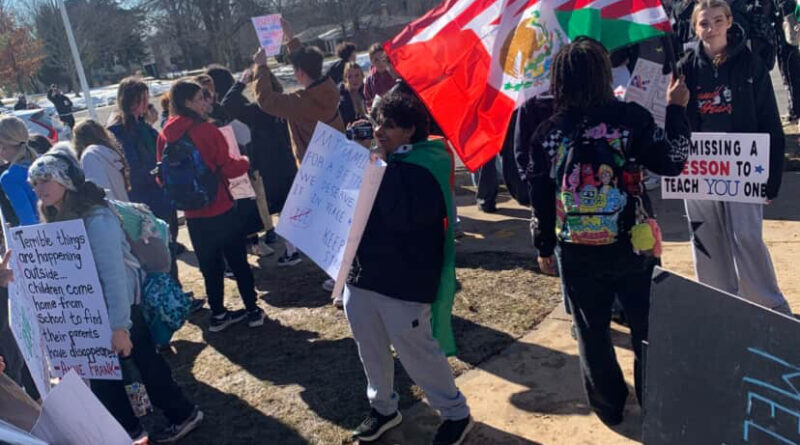
ST. LOUIS COUNTY, Mo. On January 30, 2026, more than 1,000 students across Webster Groves and Kirkwood walked out of class to protest U.S. Immigration and Customs Enforcement and recent federal immigration enforcement actions. The demonstrations were part of a broader nationwide movement, but for many students, the protest felt deeply personal and local.
Students from Webster Groves High School, Kirkwood High School, and Nerinx Hall stepped into the cold morning carrying handmade signs reading “No Human Is Illegal” and “Protect Families, Not Fear.” According to local reporting, more than 1,000 Webster Groves-area students participated.
The walkout at Webster Groves came together in just two days.
“We put our minds to it, and we got it done,” said Kiran Bergfeld, one of the organizers. Students were motivated after learning about a national strike and reports of ICE activity in St. Louis. For many, the urgency felt immediate.
Participation did not come without consequence. Students who left class received lunch detentions or unexcused absences. Organizers described the decision as an intentional act of civil disobedience. Accepting punishment, they said, was part of the message. If democracy promises freedom of speech and civic participation, they believed it was their responsibility to exercise those rights, even when inconvenient.
Several students described wrestling with the meaning of national ideals in the weeks leading up to the walkout. Words like liberty, justice, and freedom are recited daily in classrooms, yet some said they struggled with whether those promises felt equally real for every family in their community.
For Cassie Fischer, the protest was rooted in empathy.
“All of the students who walked out care about our humanity and empathy,” she said. “They also care about our country and the democracy that we have to participate in to protect.”
One moment stood out to her in particular.
“Right when me and my two friends, Ruby Reeves and Kiran Bergfeld, led the crowd in the beginning of the walk, seeing how many people joined in was truly amazing,” she said. “While walking, we ran into the middle schoolers and high-fived as we passed, saying things like ‘so proud of you!’ and ‘thank you for using your voice!’ Nothing can beat that.”
Looking back, Fischer said the walkout reminded students that they are not powerless.
“It showed the students at my school we have a voice, and we can use it for good,” she said. “Lots of students feel helpless, especially right now, and this was a way to draw attention to the issue and do something.”
At Parkway South High School, students organized a similar walkout on February 6. One organizer, who asked to be identified as Pen, said many participants feel caught in a civic “grey area.”
“It can be difficult to know when and how to take a stand,” Pen said. “Would people even take me seriously? Would I be silenced as someone ‘too young to understand?’ A walkout shows that kids have autonomy. They are choosing to participate, even when there is a risk of consequence.”
Pen also delivered one of the protest’s most forceful statements directed at federal immigration authorities.
“I want ICE agents to know that they are not welcomed here,” Pen said. “You have done nothing but harm the people you claim to protect. We as a nation will not stop speaking out.”
Beyond specific policy concerns, many students framed the walkouts as a broader question about what it means to belong in a country that describes itself as the land of the free. For them, the protest was not a rejection of national symbols, but an attempt to demand that those symbols reflect reality. They said patriotism, in their view, includes holding institutions accountable and ensuring that justice extends to every family, not just some.
The demonstrations across Webster Groves, Kirkwood, and Parkway reflect a growing wave of youth civic engagement. Students say they are not content to wait until they are eighteen to participate in shaping their communities. Instead, they see themselves as stakeholders now.
“Seeing the students come together like this brought chills to my bones,” Bergfeld said. “It was incredible to see so many passionate students using their voice to stand up for what they believe in.”
For many students, the walkout was not an act of anger, but of hope. Hope that their community could be safer. Hope that empathy could outweigh fear. Hope that the ideals they learn about in classrooms might one day feel fully real.
In the cold air, surrounded by friends and classmates, they found something powerful in one another. Not just protest, but solidarity. Not just frustration, but purpose.
And as their voices carried across school grounds and city streets, they proved something to themselves as much as to anyone else: they are not too young to care, not too young to question, and not too young to demand better.
